
The Architecture of Frustration: Why Bryan García Agudelo Wants Geometry to Misbehave
On Control, Error, and the Inner Life of Architectural Systems.
Elizabeth Lotz
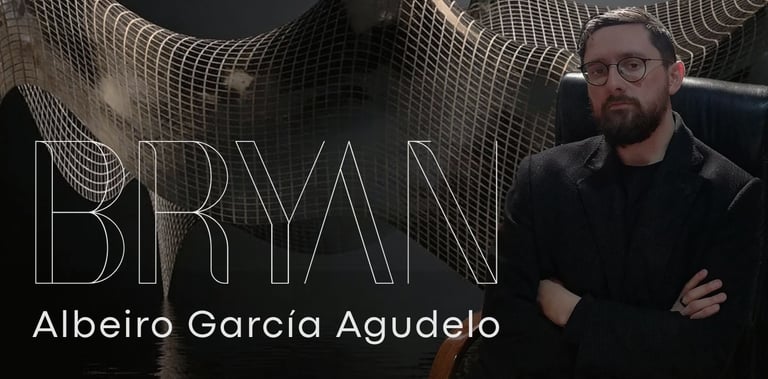
García Agudelo’s work carries a commanding presence that unmistakably reflects his dedication to his artistic vision. I want to say “quietly heroic,” but that sounds too indulgent. Still, it’s exactly what it is.
Whether in his studio in Alicante, imparting knowledge to others, or collaborating with forward-thinking firms like GEA Architects and PARTISANS, his methodology remains consistent. Monumentality emerges through unrelenting curiosity, dogged persistence, and an unyielding loyalty to the creative process.
His philosophy asks an important question: can anything truly emerge from nothing?
Unequivocally, no.
His work stands as a testament to accumulated knowledge and creative evolution. It’s built through layered experience, the confrontation of doubt, and the steady transformation of what’s been absorbed into form.
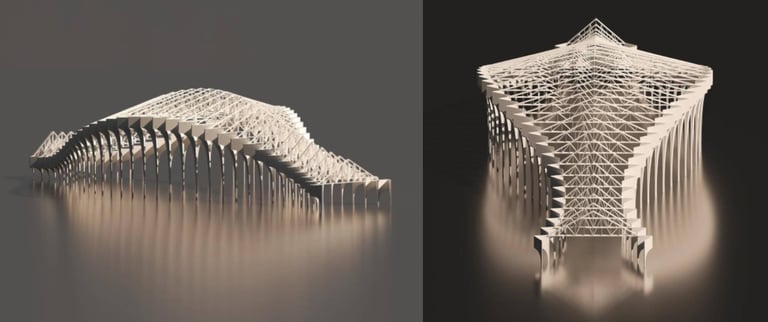
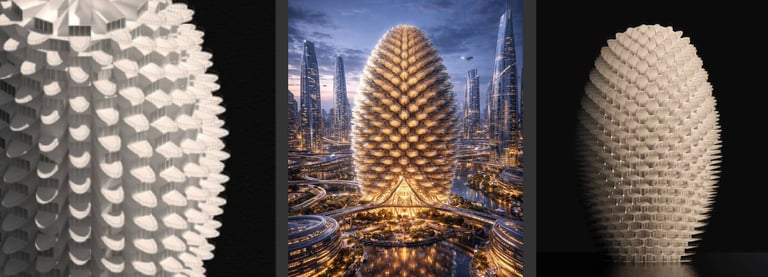
Structure and unpredictability are constantly at odds here. Take a closer look at creations like SPINE_PAVILION, you notice its skeletal progression, or the dynamic, ever-shifting tessellations of HEXA_PVLN. These designs draw you close, hint at what’s possible, then get out of the way. The structure might provide stability, but within it lies a sense of endless motion where things transform, and people engage.
I keep returning to this suspicion: that creativity is a distant deity you passively appease.
It’s anti-mystic. It’s a discipline, one that defies the romance of “waiting for inspiration.” García Agudelo understands this. For him, creativity isn’t abstract. It’s shaped by every question we’ve asked, every idea we’ve grappled with, the bits of logic we borrowed before bending them into something personal. It’s from that friction that meaning takes shape.
You don’t see this kind of work often. It’s rare. Resplendent, even, in how understated it is.
DecaDialogue: Ten Questions, One Architect
Ten questions exploring the inner logic and discipline behind García Agudelo’s work.
"Nothing comes from nothing."
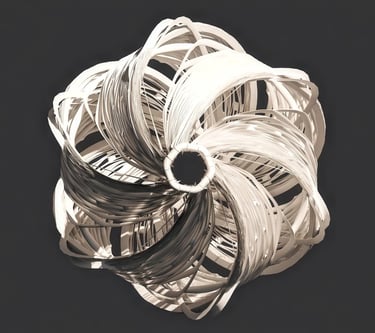
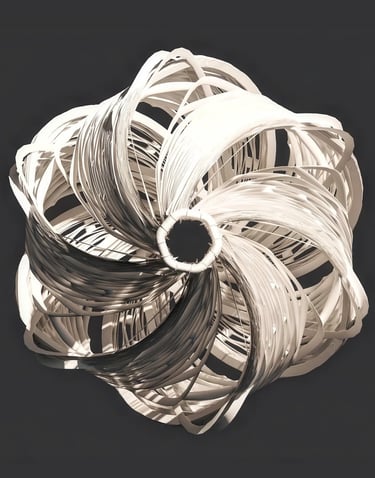
Q. Your work reframes how we experience space itself. Was there a moment that triggered this shift in perspective for you, intellectually, emotionally, or otherwise?
A. I’ve always been drawn to monumental architecture, the way scale, repetition, and rhythm can transform the way we inhabit space. Yet when I began working with more conventional programs, like residential design, I encountered a challenge: how to transpose the qualities I admired in monumental spaces into the intimacy of a domestic scale. To do so, I had to experiment with parameters that didn’t always seem to fit.
This process became an exercise not just in design, but in rethinking space itself. Intellectually and emotionally, I was forced to rediscover what monumentality could mean when stripped of sheer size. I realized it could be found in the logic of repetition, in iteration, in subtle variations that accumulate into presence. That realization gradually led me toward parametric design.
Parametric tools gave me a language to play with those concepts dynamically, to encode repetition, variation, and iteration as parameters, and to explore how small shifts could generate entirely new spatial experiences. What began as an architectural exercise soon expanded: geometry was no longer confined to buildings, but became a medium for furniture, sculptures, pavilions, commercial spaces, and hybrid typologies.
In this sense, parametric design became less about form-making and more about choreographing behaviors of space, capturing the monumentality I first admired, but translating it across scales, materials, and programs. It’s that dynamic interplay between the monumental and the intimate, the fixed and the malleable, that continues to draw me into this field.
Q. Curiosity, frustration, obsession—how do your emotions translate into the physical forms and spatial experiences of your architectural designs?
A. For me, emotions are not separate from design; they are the engine that drives it. Curiosity is often the spark. It pushes me to ask “what if?” and to test parameters that might initially seem counterintuitive. That curiosity manifests spatially as variation. I’ll generate multiple iterations of a form, each one revealing a different possibility for how light, structure, or circulation might interact.
Then comes frustration, which I see as a productive force. When something doesn’t work, when parameters collapse, or the geometry resists coherence, it forces me to rethink assumptions. That tension often leads to breakthroughs, because the solution rarely lies in forcing the form, but in shifting perspective. Many of my most surprising spatial experiences have come from embracing frustration as a design collaborator.
Finally, there’s obsession, the willingness to iterate endlessly, to refine a script, to tweak a parameter until a design begins to breathe on its own. This persistence is what translates abstract experimentation into tangible atmospheres. Obsession manifests in the rhythm of repetition, in the subtle variations that give a space its character.
Together, these emotions shape my work into spaces that feel alive, spaces that don’t present themselves all at once, but unfold dynamically as you move through them. In that sense, the emotional journey of designing is embedded in the physical and experiential journey of inhabiting the architecture.
Q. Your work suggests a balance between systematic control and a kind of spatial freedom. What attracts you to fuse precise mathematics with organic form, and how do you decide when to let order give way to unpredictability?
A. What attracts me most to parametric design is precisely that tension between control and freedom. Mathematics and scripting give me a framework, an underlying order that allows me to set relationships, repetitions, and rules. But within that system, the true beauty emerges when I let the parameters breathe, when I allow iterations to reveal patterns I didn’t initially anticipate.
I see mathematics as a kind of scaffolding. It provides precision, clarity, and coherence. But if I stay only within the system, the work risks becoming sterile, too perfect, too predictable. The moment I allow a degree of unpredictability, whether by introducing irregular inputs, pushing a parameter beyond its comfort zone, or even accepting the errors a script produces, the work gains a kind of organic vitality. That’s when space stops being purely rational and starts to feel alive.
Deciding when to give way to unpredictability is less about a formula and more about intuition. I usually know it’s time when the geometry stops surprising me. At that point, I push the system until it reveals something unexpected. For me, that balance, between the rigor of mathematics and the freedom of emergence, is what makes parametric design so compelling. It allows me to move fluidly between control and discovery, creating spaces that are both precise and poetic.
Q. At the outset of a project, how do intuition and logic shape your initial approach, do they collide or converge, and what guides that interplay as the design begins to take form?
A. For me, intuition isn’t a magical element; it doesn’t appear out of nowhere. Intuition is built through knowledge, through experience, and through the discipline of constant practice. In my own case, I challenge myself to create at least one design a day. Over time, this repetition becomes a kind of intellectual exercise that sharpens my instincts, gradually shaping a personal sense of what design should be.
At the outset of a project, that intuition meets logic in constant dialogue. Intuition gives me the first impulse, an atmosphere, a rhythm, or a spatial quality I want to explore, while logic provides the framework to test and articulate that impulse through systems, parameters, and relationships.
As you accumulate many iterations, you start to understand what consistently draws your attention. That self-awareness gives you direction: the ability to guide a design without forcing it, to let it evolve while still being open to tangents and unexpected discoveries. Intuition becomes like railings, providing grounding for the design to walk on its own, while still leaving space for surprises.
I also live by the philosophy that “nothing comes from nothing.” The more references and precedents you study, the more starting points you accumulate, standing on the shoulders of giants, so to speak. That reservoir of knowledge feeds both intuition and logic, enriching the interplay between them. And while intuition can sometimes risk pushing a design too far in one direction, or logic can over-constrain it, the most compelling work emerges when the two converge, when the systematic and the emotional reinforce one another to produce spaces that feel both precise and alive.
Q. When a budget or brief collides with a concept you believe in, what’s your first instinct: re-code the system, re-frame the idea, or push back?
A. It’s a frustrating reality in our field that budgets or briefs often collide with concepts we deeply believe in. I’d be lying if I said it doesn’t get to me; sometimes it can drain energy or even make me lose interest in the design for a while.
My first instinct, though, is usually to re-code the system, to see whether parameters can be recalibrated so the core idea survives within the constraints. That adaptability is one of the strengths of parametric design. If that isn’t enough, I’ll re-frame the idea, looking for alternative ways to express the same essence, whether through material shifts, sequencing, or programmatic adjustments. And in rare cases, when I feel a concept is fundamental to the identity of the project, I do push back, not out of stubbornness, but as a form of advocacy for the value it can bring.
For me, it’s always a balancing act. Frustration is part of the process, but it also forces me to test my convictions, what can flex, what can adapt, and what must remain non-negotiable. In that sense, those collisions, as difficult as they are, often sharpen both the project and my own design philosophy.
Q. Refinement is central to architecture, but constraints often complicate the process. They are often seen as obstacles to creativity. At the same time, these very limitations can ignite innovation. Can you share a project or moment where a limitation or unexpected challenge revealed an unexpected solution, and how that experience shifted your perspective on creative possibility?
A. One project that stands out was a small façade where the initial concept relied on CNC-cut panels. The idea was to cut two-dimensional pieces on a flat plane and then assemble them on-site to create a three-dimensional design. It was a precise and effective approach, but when budget cuts affected our portion of the project, we had to rethink how to achieve the same sense of depth and dynamism with far fewer resources.
Instead of scrapping the design, we reinterpreted it using the most accessible material available locally, brick. Through parametric design, we developed rules for how each brick would be rotated or projected outward, creating a façade that appeared wave-like and kinetic. This reinterpretation didn’t just substitute the material; it enriched the design. The shift to brick gave us the opportunity to layer in new concepts of permeability and light, something that might not have emerged in a typical CNC-cut façade.
To make the process practical for construction, we devised a simple communication method for the masons, breaking the façade into fragments, much like an artist maps a painting onto a grid. Each section was labeled and easy to follow, allowing the builders to reproduce the complexity of the design without needing digital tools (needless to say, this was also included in the parametric script).
The final result was cost-efficient, roughly one-sixth the original CNC proposal, but also more contextual and inventive. That experience taught me that constraints don’t simply force reduction; they can spark reinterpretation. By recalibrating the system, we arrived at a solution that was both economical and creatively richer than the initial idea.
Q. Teaching parametric design means translating your process to others. How has guiding students or peers shifted how you perceive your own work?
A. Teaching parametric design has been one of the most revealing parts of my practice. When you guide students or peers, you can’t rely on intuition alone; you have to break your process down, make it legible, and explain why a certain parameter or system matters. That act of translation forces me to see my own work more clearly.
What I’ve realized is that teaching is itself a kind of calibration. Every question a student asks is like a test: is my logic sound, is my method adaptable, or have I been leaning too much on personal intuition? Explaining the process often uncovers blind spots in my own practice, and at the same time, their fresh perspectives push me to reframe ideas I thought were fixed.
It’s also shifted how I think about accessibility. A parametric script can look like a black box from the outside, but teaching has reminded me of the importance of clarity, of finding simple ways to communicate complex systems. That mindset carries over into my design work as well. If a builder, client, or collaborator can’t understand the system, then the design hasn’t fully succeeded.
Ultimately, teaching has reinforced for me that parametric design isn’t just about generating forms, it’s about cultivating a way of thinking that balances logic, intuition, and adaptability. Sharing that with others has deepened my own understanding of why I’m drawn to this approach.
Q. Your work is often described as dynamic. Do you engineer that sense of movement, or does it emerge through gradual development, and how do you recognize when it's truly come to life?
A. For me, dynamism is both intentional and emergent. Over time, through countless explorations and experimental scripts, you start to discover what I call “cheat codes” for movement, gradual variation, shifts in density, and layering geometries. At first, you don’t even realize you’re learning them; you never know what’s useful until suddenly it is. Eventually, those experiments accumulate into a kind of muscle memory: the technical knowledge becomes so internalized that intuition naturally pushes you toward more fluid, dynamic outcomes without much conscious thought.
At the same time, most of my work wasn’t conceived with movement as the primary goal. Dynamism often emerges naturally from the scripting process itself. A script is like a growing force; you keep layering, adjusting, recalibrating densities, and the system begins to evolve into something that carries its own sense of motion. It’s less about forcing movement and more about recognizing when it has surfaced.
I know a design has truly “come to life” when it feels like it has agency, when the geometry behaves in ways that surprise me but also feel inevitable. That’s when the logic of the system and the perception of space converge, and the work starts to move, even while standing still.
Q. If you had to distill creativity into a single idea or principle, beyond any specific discipline, how would you define it?
A. If I had to distill creativity into a single principle, I would say: nothing comes from nothing. No one is born creative; what we call creativity is built by learning from others, by studying references and precedents until they become part of your own way of seeing. The more you expose yourself to, the more raw material you have to merge, reinterpret, and evolve into something new.
At the same time, creativity is personal. Each of us filters those references differently, drawn to what resonates most, whether it’s patterns, rhythms, atmospheres, or emotions. Finding that affinity usually takes time, effort, and a lot of experimentation. But once you discover what draws you in, creativity stops feeling optional; it becomes an itch you have to scratch.
For me, that itch is strongest when I sense an idea but can’t yet translate it into a script. It’s frustrating, almost unbearable at times, but that tension is what drives me forward. In the end, creativity isn’t a gift; it’s a discipline of learning, filtering, and constantly pursuing the ideas that refuse to let you go.
Q. Finally, in your experience, what’s the most important question about creativity that isn’t being asked enough, but should be?
A. I think a question that isn’t being asked enough is, "Am I truly being creative, or am I just copying others?" And the truth is, copying is not inherently bad; it’s how we all learn. Studying others, absorbing references, and imitating techniques are the foundation of growth. Nothing comes from nothing.
But at some point, we have to push beyond replication. Real creativity comes when you take what you’ve learned, filter it through your own sensibilities, and allow yourself the freedom to experiment, to fail, and to discover your own direction. It’s in that space, between influence and independence, that originality begins to emerge.
So for me, the question isn’t whether we’re influenced by others; we always are, but whether we’re giving ourselves enough room to transform those influences into something authentically ours.
Visit his personal website: www.archbga.com.
Follow his projects and updates on Instagram @bryan_garcia_agudelo
Access his teaching and community platform at Skool – The Parametric Circle.
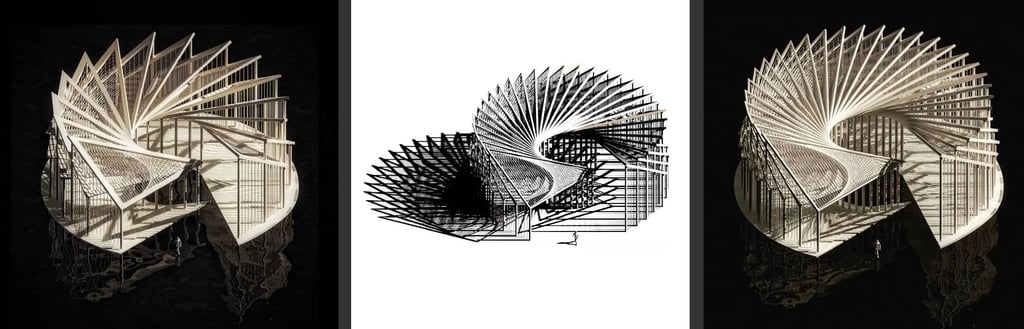
When people expect creativity to arrive fully formed, they often abandon it too early. I’d also want it to be neatly packaged like a gift from the universe, but it never is.
Creativity crashes in, makes a mess of your plans, and slips away just when you think you’ve finally caught it. Psychologists talk about this slowdown as resisting entropy… the mind’s pull to settle into easy, predictable patterns. It’s a pretty virtuous label, but it doesn’t help much when you find yourself stuck. The turning point comes when familiar approaches cease to be effective. The work pushes back against your initial assumptions and drags you into revisions you didn’t see coming. Inspiration no longer leads; limitation does, and the work grows from there.
Some spaces do the same thing. They disrupt and change how you move through them. The Salk Institute’s courtyard empties your mind, the Guggenheim’s ramp alters your pace, and it’s all by design. This is the psychological atmosphere of space where you’re not in control, but you can’t escape the influence.
Through the creative unconscious, parametric architect Bryan Albeiro García Agudelo's work turns design into a hero's journey, which causes an intriguing form of perceptual disturbance. At first, I thought this was just a formal complexity. Turns out it was more. The geometry doesn’t settle. It’s almost endless, like some fractal machine running on its own. Then there are the patterns. They feel familiar, but only long enough to make you think you understand. Then, they don’t.
That split-second hesitation keeps showing up, both in his teaching and in his work. You can think of him as a poet of behavior; a designer who scripts the way we move through a space.
Grandeur Without Distance
García Agudelo had a fascination with spaces so vast that they erased any sense of conceit. Plazas, cathedrals, the kind of places that make you aware you’re not in charge.
But he didn’t start out there. It started with houses and apartments. No sweeping arches, no sheer-size-awe; spaces where you notice the consequences. Move a wall, and you’ve changed how someone eats dinner. The anti-cathedral, if you want (I wrote that down and crossed it out twice).
García Agudelo’s approach is to embrace variability and constraints, turning potential limitations into creative catalysts. Qualities such as light, proportion, and subtle enclosures shape space, and you notice how the presence arrives after a while. It’s as if the spaces shift and respond. But, only within the rules he set, and then just bent enough to diverge.
Parametric scripting can generate countless variations. The rules are tight on paper. In practice, that’s where it gets interesting. Frustration sets in, and geometry pushes back. It’s his preferred method because it asks for engagement. Focus sharpens, and understanding comes through repetition. He moves forward by staying with the resistance.
As proportions resist change and rhythms fracture, new possibilities arrive. The process becomes obsessive. You can’t plan it. That’s the point. And the space carries the history of those decisions.
You don’t “solve” the work; it keeps asking for more.
Rules That Want an Argument
There’s a cold criticism attached to parametric design, as if it reduces spaces to mere calculations that could be solved instead of felt. But mathematics is neutral; how you use it is where expression happens.
Math is a provocation when you look at García Agudelo’s work. You can almost see him wrestling with the same question over and over. He wants the geometry to misbehave. In this pushback, design gains agency and becomes alive. The interaction between system and response makes me think about Living Structures. Spaces really do wake up when you loosen the rules enough to let in some unpredictability. That’s where meaning begins to register.
He brings that same energy into his teaching. It’s a form of calibration for him, a way of gaining knowledge through conversation and questioning assumptions. He’s not confronting what he knows when a student asks, “Why does this parameter exist?” He’s confronting why he thinks he knows it. Understanding is something you arrive at, not a possession.
The Long Exit From Imitation
How long do you linger in the shadow of others? That’s what creativity wants to know. At first, I didn’t answer that honestly. Few actually do.
What I’ve absorbed about creativity from García Agudelo is that it builds on what came before. You imitate first, then you start to move past what you borrowed. We all start out picking up on someone else’s thinking before we trust our own instincts. The protégé effect. The uncomfortable reality is realizing how long imitation actually lasts. When it comes to safety and risk, there’s a thin line. Stay too long in imitation, and it becomes stagnant. Push too fast, too far, and the process breaks.
He debunks the myth of the solitary genius by emphasizing that “nothing comes from nothing.” Candid about his influences (“standing on the shoulders of giants,” as he puts it), he absorbs their logic and moves beyond it. For García Agudelo, real originality shows up when you get obsessed, when you are pushed to give more than you planned to give, and in what you choose to do differently. It’s not as neat as the myths might suggest, but it’s far more authentic and compelling in its complexity.
The allure of the “void” holds little interest for him. What matters is the discipline of apprenticeship. Even then, originality resists being confined by influence.